

The Elizabeth Peratrovich Day celebration was just what I needed — I know it’s only one small chapter in the book of time bending toward justice, as Martin Luther King Jr. said—but it felt bigger.
The event, on a Tuesday morning at 9:30 in the Haines School gym, honored the memory of Alaska’s great civil rights leader, Elizabeth Peratrovich. Back in 1945, the Lingít woman with roots in Deishu (or Haines) gave a speech that inspired the passage of our state’s anti-discrimination law, the first of its kind in the country. She was motivated by the racism she and her husband Roy, also Alaska Native, faced when he took a job in Juneau with the government. They couldn’t live in a house near his office, send their children to a good school, go to movies or even eat out. “No Natives” signs were legal.
She was the final speaker before the legislature’s second vote. The first one, two years before, had failed. She said,“I would not have expected that I who am barely out of savagery, would have to remind gentlemen with five thousand years of recorded history behind them of our Bill of Rights.” She also said, “Either you are for discrimination or against it,” and that discrimination is the “currency” of “the great superman who believes in the superiority of the white race.” When a lawmaker who made racist comments during the debate, asked her if she actually believed that a law would end discrimination, she asked him if outlawing murder had ended homicide. The intent counts.
Elizabeth Peratrovich Day became a holiday in Alaska in 1988, but there are still plenty of Alaskans that can’t pronounce her name. Even here it wasn’t very long ago that a handful of women from the Haines and Klukwan Alaska Native Sisterhoods gave the first presentation to the school. Elder Marilyn Wilson was their spokesperson. She stood in the middle of the gym, wearing her blue and white ANS sash and cap and read a brief biography of Mrs. Peratrovich. The Charlie Brown sound system muddied her words. It lasted less than fifteen minutes.
Our town’s biggest celebration of Elizabeth Peratrovich Day yet lasts for over an hour and is followed by Native Youth Olympic games. The school principal tells the students that we remember her story because she was an ordinary woman who did something extraordinary. He says we can all be like Mrs. Peratrovich and notice wrongs, big and small, and make them right. A tribal administrator reminds the children (and adults) to be kind and respectful. To honor our differences.
The music teacher (who is not an old hippie by a long shot) directs the high school choir in Blowin’ in the Wind. Before they sing, he reads the lyrics.
Yes, and how many times can a man turn his head, and pretend that he just doesn’t see?
In Marilyn Wilson’s generation, Alaska Native society was nearly destroyed by government, church and school authorities. More recently there are the news-making revelations (to non-Natives anyway) about sickening atrocities committed at boarding schools and orphanages where Native children were sent, often against their family’s will. The gym we are in used to be named in memory of a superintendent that committed horrible crimes against mostly Native boys.
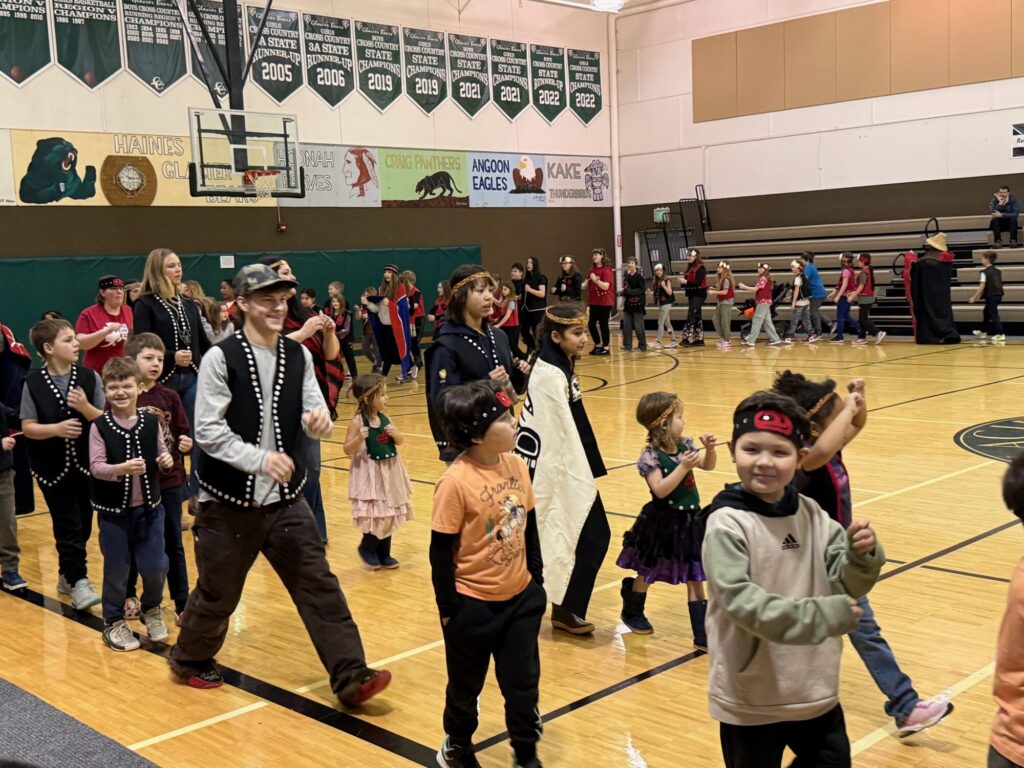
Now it’s full of joy, pride and a kind of wonder. Love, too. A lot of love. How did we get here, and isn’t this grand? Students of all backgrounds, basketball stars and kindergarteners, wear regalia they have made in their classrooms. For months, local experts have guided the non-Native PE teacher in the ways of Lingít dance and they praise his efforts. After the songs and speeches, the bleachers empty into a river of children and adults. Some folks are cautious, they don’t know the moves, or are shy about dancing in public, but a Native leader cheerfully calls out the bench-sitters by name, she won’t take no for an answer —we all belong here– and so we sway and step, some easily, some awkwardly to the heartbeat of the drum and the ancient language of Here.
Marilyn moves slowly, holding a friend’s arm, so I take the other side. “I will make it,” she assures us. “It is very emotional,” she says. Her cheeks are wet and she is smiling. She is not alone. “I wouldn’t miss this for the world, ” she says.
This is a kind of mercy, isn’t it?


